What the assistant is for, and how to drive it
wildlifeconservation.ai is four agents over four decades of funded conservation. Here is what each one is good at, what none of them will do, and the handful of habits that separate a useful answer from a vague one.
NFWF has been funding conservation since 1984. The consequence, forty years on, is that most questions a grantee or a partner actually has — has anyone tried this in my watershed, what did it cost, who else was at the table, what does this program count as match — already have answers somewhere in the Foundation’s own record. They are simply not reachable. They are distributed across proposals, budgets, interim reports and final reports, in quantities no one is going to read.
wildlifeconservation.ai is an attempt to make that record answerable in a sentence. Not a chatbot bolted onto a website: a research companion for the people doing the work, pointed at the archive that documents it.
Two design commitments follow from that, and they are worth stating up front because they explain a lot of the tool’s behavior. The first is that it optimizes for outcomes on the ground rather than for engagement — it is not trying to keep you in the window, and when the honest answer is that we do not know, that is the answer you get. The second is that every substantive reply carries its sources, because the fastest way to judge whether an answer can bear weight is to look at what it was built from.
Who is in the room
The assistant is not one model with one personality. It is a small roster of agents with different jobs, different tools, and deliberately different temperaments. You pick one in the left sidebar, and that choice matters more than how you word the question.
Conservation Q&A is the fast tier, and the right default for anything mechanical about grants: who is eligible, what counts as non-federal match, whether indirect costs are allowed, when progress reports are due. It answers in a paragraph or two with the relevant program named. It is not a substitute for the funding opportunity itself — program-specific rules live in the RFP, and the agent will tell you so rather than guess on your behalf.
Conservation Research is the deep tier, and it behaves like it. Given a real question it states a plan before it queries anything, then works at least two independent angles before it will commit to an answer — funded-work records tell it what was tried and reported, published science tells it what works, program strategies tell it what the Foundation prioritizes. Numbers come from tool results, never from the model’s memory; where sources disagree, the disagreement is reported as a finding rather than smoothed away. This is where “oyster reef outcomes on the Texas coast” or “who funds coastal resilience” belongs. It is slower on purpose.
Seeding Conservation runs in the other direction. Instead of answering a question you brought, it looks for the intersection of three things: unmet need visible in the pattern of what has and has not been funded, what NFWF is currently prioritizing, and what your organization is demonstrably equipped to take on. The output is an opportunity you could realistically pursue, which you can then narrow — widen the geography, fit it to a $250K budget, ask who else is already working there. Worth being clear: a surfaced opportunity is a lead, not a commitment to fund.
Proposal Review works a draft with you before you submit. It starts by pulling the currently open funding opportunities from nfwf.org, asks which one you are aiming at, then asks the things it needs to be useful — organization type, location, species and habitat, project type, partners, budget and cost-share — a couple of questions at a time rather than as a form. From there it works section by section against that program’s own stated priorities and evaluation criteria. It is guidance for strengthening a proposal. It is not a funding decision and cannot hint at one.
The roster is administered, not fixed, so what is in your sidebar is what has been turned on for your account. If an agent you expected is missing, that is a configuration question rather than a bug.
Driving it well
Most disappointing answers trace back to one of five habits, so here they are in the order they tend to bite.
Pick the agent before you write the question. Asking Conservation Q&A for a synthesis of the literature, or asking Conservation Research when a report deadline is due, produces a mediocre version of an answer another agent would have given well.
Read the starter chips even when you do not click them. The row above the composer — Popular, Relevant to you, Try, depending on the agent — is the cheapest available guide to the shape of question that agent is built for.
Brief it like a colleague, not a search box. Geography, species, budget, timeframe, and what you are trying to decide. “Oyster reef outcomes on the Texas coast” gets somewhere; “tell me about oysters” does not. If you are working a proposal, paste the section you are stuck on — the agents read what you give them, and specifics are what they have to work with.
Watch the status line while it works. Research narrates what it is doing as it goes, and a long pause with a status line moving is the agent triangulating, not the page hanging. A turn that takes a minute is often a turn worth waiting for.
Follow the thread rather than starting over. A conversation keeps its context, so a follow-up is cheaper and better than a fresh question that restates everything. Suggested follow-ups appear at natural decision points. Recents in the sidebar holds your last twenty conversations, which makes it a working memory rather than an archive — if a thread matters beyond this week, copy what you need out of it.
A few smaller things that are easy to miss. Answers that compare a handful of comparable things — species, projects, opportunities — render as cards rather than prose. A full analysis, like a proposal review or a seeding brief, opens in a side panel you can read alongside the conversation. Each message carries its own controls to copy it, ask the question again, or pull it back into the composer to edit; note that editing seeds a new question rather than rewriting what came before, because the transcript on the server is a record of what was actually asked. The thumbs under a reply are read by us. The ring beside your name is your daily allowance, which is counted in tokens rather than messages — one deep research turn can cost what fifty quick questions would, which is exactly the trade the two tiers exist to let you make.
Getting in, for completeness: access is by invitation during the pilot. Sign-in is open — Google, Microsoft, a one-time email link, or a passkey — but signing in is not the same as being approved. An unrecognized address becomes a pending request that a human reviews, rather than a door that silently fails to open.
Where this actually stands
It is a beta, and it says so under the composer. Some side panels still show clearly-labeled placeholder content while the agents behind them are wired to live data; where you see that label, believe it. Everything the assistant produces is AI-generated, and NFWF is not responsible for AI-generated content — verify anything you are going to rely on, particularly numbers, deadlines, and eligibility. Please do not paste personal information about grantees, applicants or staff into it.
And the deeper caveat is not about the software at all. The archive underneath is a remarkable record and a partial one, in specific and knowable ways — an absence of funded projects in a county is not evidence that nothing was needed there. That is worth understanding before you lean on any answer built from it.
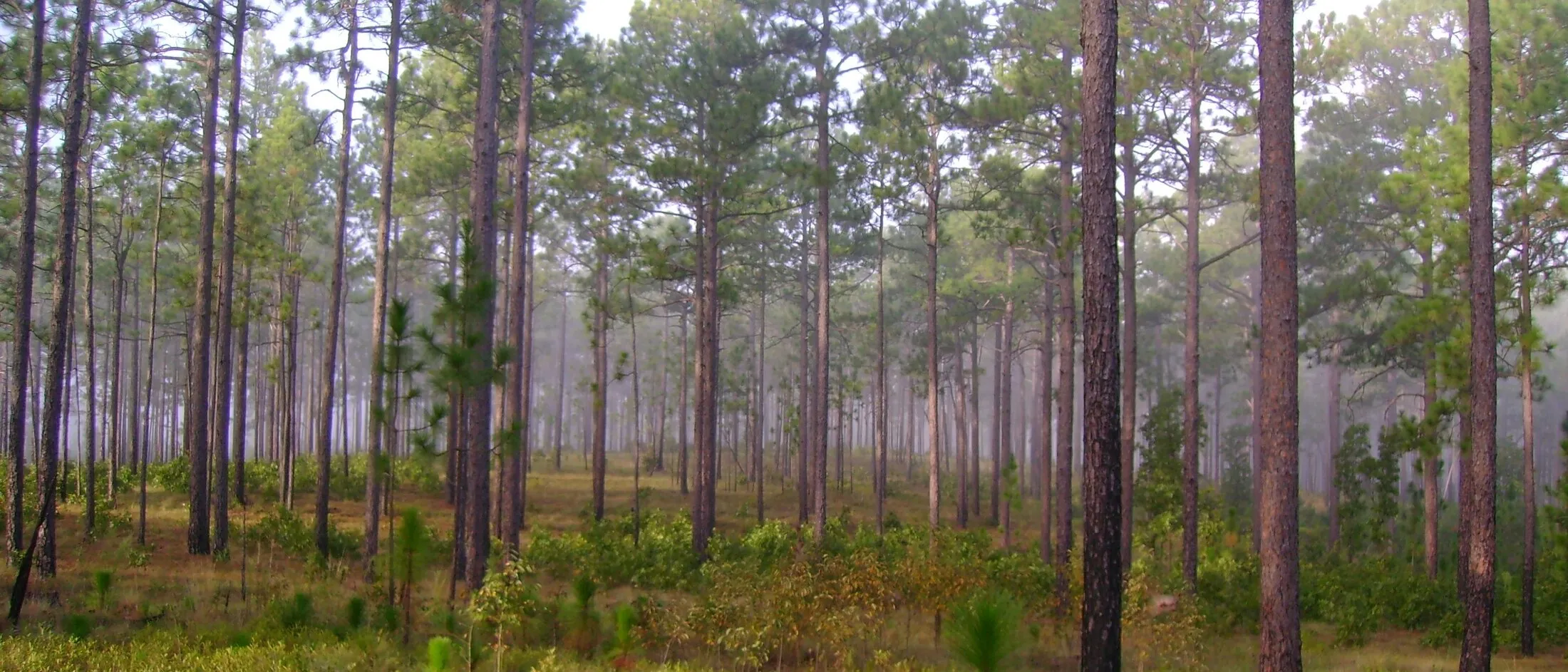
Photograph: longleaf pine savanna at Carolina Sandhills National Wildlife Refuge, U.S. Fish and Wildlife Service (public domain).